
By Holly Latteman, Director of Science & Research at The Dawes Arboretum
From birth to adulthood, trees are displayed like artwork at The Dawes Arboretum. They live full, healthy lives from small seedlings in our warm greenhouses to staggering and otherworldly heights around the grounds.
Every twist and turn around The Arboretum showcases different types of beautiful trees. Whether it’s the uniqueness of our four nationally accredited collections: the dawn redwood, maple, buckeye and horse-chestnut and witch hazel; our blooming Azalea Glen in the spring; or our Holly Hill collection shining against winter snow, Dawes shares beauty through nature.
Just as an art museum must archive its paintings, The Arboretum must keep an accurate record of which seeds we’re using so future staff and researchers at Dawes can continue to maintain the collections we now care for. Museums are sometimes like a stamp in time, and we’re “stamping” the living collections of today for the benefit of the future through The Arboretum’s Sustainable Seed Bank.
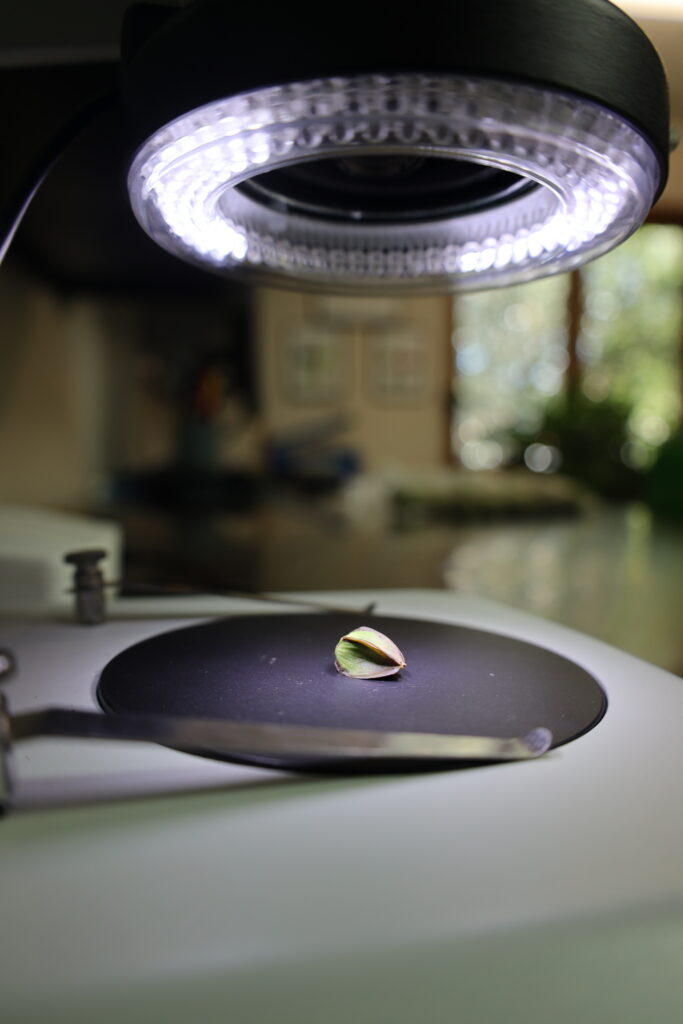
Seed banking is the process of collecting, cleaning and storing seeds that will have an impact on biodiversity research. The Arboretum’s Sustainable Seed Bank was founded approximately four years ago with the support of the Science & Conservation Team here at The Arboretum. We recognized the importance of focusing on native plants and the idea of the bank began.
It’s so important to keep an abundance of native plants in case tragedy hits. For example, there are pests, like the emerald ash borer, that can completely wipe a native plant species off the map. By banking seeds, we are protecting species from extinction while collecting and recording information for the future of The Arboretum, biodiversity, and the environment.
We focus on seed collection for the purpose of restoration, species conservation, and education. Seed collection occurs year-round and features a wide variety of species. The Arboretum mainly banks seeds that are classified as orthodox species, meaning seeds that can be dried and frozen.
Dawes is one of three seed banks in Ohio, and one of 22 seed banks in the United States. That means we make up 33% of the archival seeds in Ohio and 5% of archival seeds in the nation.
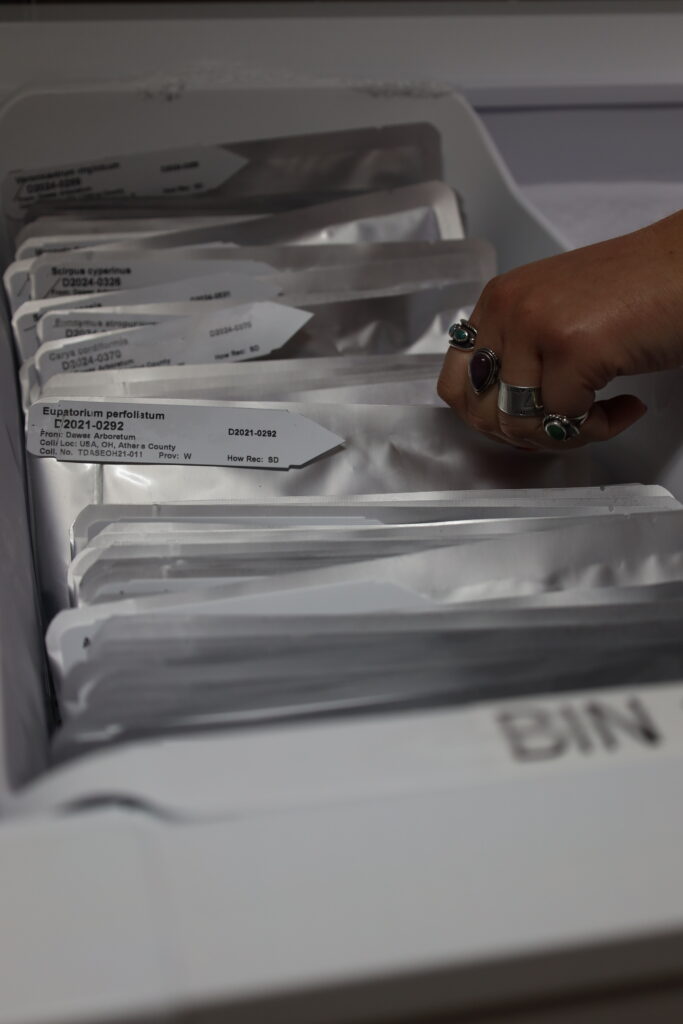
At The Arboretum, we bank seeds by storing them in a way that preserves them with the potential to last decades. We do so by lowering the humidity, freezing the seeds, and storing them in mylar bags which prevents freezer burn. The other way we bank seeds is in our living collections on the grounds. Certain species are recalcitrant, meaning they are unable to be banked by traditional methods and must be kept in a living collection for preservation.
A prime example of seed preservation in a living collection is our collection of oaks. We are a part of the Global Conservation Consortium for Oak, an initiative that began in 2019. Led by The Morton Arboretum in collaboration with Botanic Gardens Conservation International, the program was created to prevent extinctions and ensure healthy oak species for the future. This seed cannot be banked because the embryo will break in the freezer; the only solution is to grow the species within our grounds. The Arboretum’s living collections are comprised of more than 14,000 labeled specimens, with 63% of species being of wild-known origin. Wild-known origin is used to promote genetic diversity in a species, which allows for increased viability and longevity.
We follow the guidelines provided by the Center for Plant Conservation and the Millennium Seed Bank. Doing this preservation work has allowed researchers to have an impact on both the creation and analysis of their project. It also allows them to impact species that are rare or threatened in their natural habitats. By using seed banking and growing species, we’re preventing extinction of species and promoting genetic diversity.
A prime example of this important research is our partnership with the Ohio Department of Natural Resources. Dawes grows the Western wallflower, a state endangered species, for reintroduction into suitable habitats. Seed of this species is preserved in the Dawes Sustainable Seed Bank and the Dawes Herbarium (DAWES). Researchers will be able to study the preserved herbarium voucher and add to the gene pool of this species by using historical vouchers that were created through the seed bank.
Through our preservation techniques, in 50 years people will understand why we did what we did here at The Arboretum. They will be able to grow things that are threatened and learn about the history of the landscape at Dawes. It is an archival tool that allows us to preserve the living history of today for the betterment of tomorrow.
This work is possible through the combined efforts of our dedicated Science & Conservation team here at Dawes, which includes but is not limited to our seed bank coordinator, nursery manager, conservation team, and the Landscape and Operations team who care for our living collections. We uphold our mission of enriching lives through the conservation of trees, nature and history through our seed preservation, conservation and promotion.
About The Dawes Arboretum
Founded in 1929 by Beman and Bertie Dawes, The Dawes Arboretum is a living museum celebrating the history and beauty of trees and nature. Located in Newark, Ohio (30 miles east of Columbus), The Dawes Arboretum offers paths, trails and boardwalks to explore along with historical and art exhibitions and educational programming. The Dawes Arboretum is recognized by the National Register of Historic Places and is open daily. Admission is free to members and $10/adults, $5/children ages 5-15 and free/children under 5 years of age. Free and reduced options exist. Additional information on visiting, programming, history and membership is available at www.dawesarb.org. Follow Dawes Arboretum on Facebook, Instagram, and LinkedIn @thedawesarboretum.
Holly Latteman received her Bachelor of Arts in Zoology, Sociology/Anthropology, and Environmental Studies from Ohio Wesleyan University in 2017, going on to earn her Master of Science in Environmental Studies from Ohio University in 2019, where her research focused on black vulture range expansion and human-wildlife conflict.
In addition to her educational accolades, Holly possesses a vast and multi-faceted range of research experience, including analysis of feather-degrading bacteria in common yard birds, bacterial load and monitoring of avian nest boxes, diet and paternity studies in captive bird species, reforestation research, restoration research, right-of-way vegetation and wildlife presence, and phenology tracking across various taxa.
Holly currently serves as the Director of Science and Research at The Dawes Arboretum, where she leads the living collections, plant records, herbarium, and nursery. Dedicated to bridging science and community, she evaluates current research projects and communicates outcomes to both the scientific community and the public.
During her time at the Arboretum, Holly has continued to drive critical initiatives, managing the collection of native seeds for restoration and conservation projects with over $330,000 worth of seed collected. She also directs the Advanced Training Program, which prepares future conservation leaders to contribute positively to environmental fields through residency opportunities and AmeriCorps service partnerships.

