By A Nearly Native Nursery
If you’ve ever seen a plant marked “endangered” in a botanical garden, did you ever wonder how it got there? When a curator wants to bring a rare species in, who gets the call?
For native Southeastern plants, one of the critical sanctuaries—whose offspring are seen from the US Botanic Garden in DC down to the Chattahoochee River and westward to the Mississippi and beyond—now finds itself endangered as its owners and primary labor force, Jim and Debi Rodgers, enter retirement. Without heirs to the enterprise, the Nearly Native Nursery in Fayetteville, GA, risks being bulldozed and developed to serve the nearby school, church, and neighborhood.
“If I could, I’d stay here forever,” says Debi. “But the reality is, we’re getting too old for the work.” The sprinklers are watering rows of potted saplings while the Rodgers’ Macaw, Butters, cracks nuts on the walkway and keeps an eye on us. “It would absolutely break my heart to see this beautiful, productive, educational space destroyed to put up a gas station or something else we already have dozens of. Where will the animals go? Who’s going to make sure all these plants are producing seedlings that survive?”
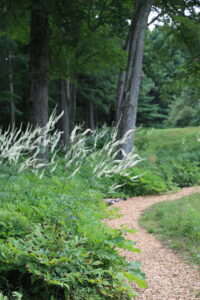
The nursery itself is an arboretum, a dense ecosystem of plants, from the almost invisible purple trillium sheltering in the undergrowth to the magnificent towering oaks whose canopy offers shade and food and shelter to the wild things. Its narrow pathways literally buzz and hop with life in the warm seasons, and as a guest it’s easy to forget that what’s going on in this beautiful space is actually very serious business.
Point to a plant, and Jim can tell you where it still survives in the wild, how well its doing, and where it thrives if you want to plant one. Take the Franklin tree, Franklinia altamaha, which looks like a small magnolia but is kin to tea bushes and camellias. William Bartram encountered this plant alongside a Georgia river in the 1700s, collected seed from it, and it’s never been seen in the wild since. But here it is, still going after all these years.
And along with it, a passle of Southern kin from the common to the rare and unusual—Georgia oak, leatherwood, trillium, downy goldenrod, fringed catchfly, smoketree, Everglades bully, and hundreds more. (Those are some common names, anyway. Once on nursery grounds, it’s Latin only so as to avoid confusion.)
Naturally, this oasis of around a thousand species of Southern trees, shrubs, and other flora has grown into an annual stopover for migratory birds and butterflies, while its paths and frog ponds serve as a living classroom for kids and grownups alike. Depending on the time and season, you might catch sight of bobwhite, wild turkeys, any number of woodpeckers and hummingbirds, screech owls, yellow-billed cuckoos, even osprey or bald eagles. And on the ground, rabbits and gray fox and black racer snakes and hosts of other critters you’ll never see.
Jim grew up exploring the woods of Fayette County in the 1970s, while Debi roamed the waterways around Miami in her dad’s swamp buggy. They met in Georgia in the 1980s, settled in Gwinnett County, and began rescuing cool and rare plants from construction sites and forest land marked for clearing around their home, transplanting them to their yard.
They ended up collecting a few hundred species and reading several dozen books, and were compelled by the urgency of preserving native plants. Jim returned to college to study botany, where he helped establish the native plant garden at what’s now GSU Perimeter College, and thus the conservancy was born. In the ‘90s, the couple transplanted to the Senoia/Fayetteville area, where they’ve literally grown Nearly Native Nursery from the ground up.
“You can move a nursery, but you can’t move an arboretum,” says Debi. “The plants, the pollinators, the microbiome in the soil, the birds, the ponds, all of it works together.”
“Our natural world here in the Southeast is under increasing stress from invasive species,” says Jim — “overdevelopment, pollution, and human-engineered crops and plants. And without places like this, where natural seeds aren’t just being preserved but actually produced and propagated and planted, the world we’re adapted to can morph into a place we can’t live in anymore.”
As development encroaches, the risk to Nearly Native’s survival increases. Without a new caretaker, whether a business or private endowment or public entity, it’s all too likely that this native ecosystem and its propagation facilities will be lost within a matter of months.
“Unfortunately, our economy has no way of valuing essential assets like the maintenance of native flora,” Jim observes. “Yeah, it’s a business and it’s been our livelihood, but if the market thinks a burger joint would be more profitable here, then that’s what we’re going to get unless someone steps in to continue our vision. It’s time for us to pass the torch — we’re just wondering who out there has the passion to take it up.”
A Nearly Native Nursery
776 McBride Road
Fayetteville, GA 30215
770-460-6284
info@NearlyNativeNursery.com