By Kathy Connolly
A clear message has taken hold in fire safety: keep plants five feet away from your home.
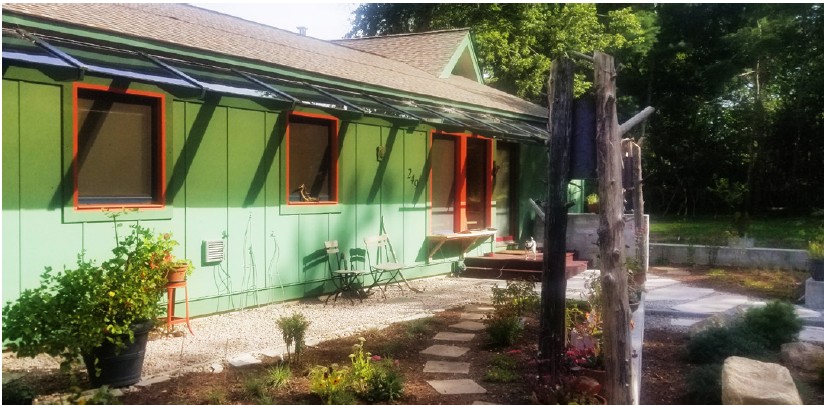
Fire protection experts and insurance companies, far and wide, recommend a five-foot open border around all buildings and attached structures — often called “Zone 0”—where no combustible materials, including plants, should be. This guidance is backed by years of research in fire science. Additional safety zones extend outward from there, often named Zones 1, 2 and 3.
But for many homeowners, the idea is a hard sell. Some western states, Canadian provinces and municipalities have codified Zone 0 through regulations, and others are strongly considering it. But there is public pushback. Many homes have mature vegetation planted close to or against the exterior, fences and decks. Removing the vegetation is, at minimum, inconvenient and expensive. It also feels like an invasion of privacy to many. Others say the idea offers little or no protection.
For those of us dedicated to increasing the presence of native plants, what are the implications? Headlines pop up here and there that seem to declare that native plants might have an advantage in a fire-protection strategy. But are native plants universally endowed with greater ability to resist fire?
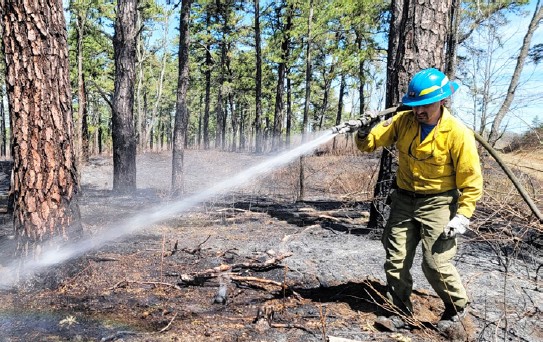
“The claim that native plants fight wildfire is too broad to mean anything,” says Dan J. Wilder, director of applied ecology at Norcross Wildlife Sanctuary in Wales, Massachusetts. “Legitimate wildfire defense comes in the form of fuel reduction, something that occurs naturally when fire moves through a system.” Wilder uses prescribed burns to manage portions of Norcross’s 8000-acre landscape.
“There are some examples of native plants that resist fire. For instance, a prescribed fire expert once told me that a line of alders (Alnus spp.) is an effective firebreak. However, on the other end of the spectrum, you have species like pitch pine (Pinus rigida) that actually help to spread fire.”
Wilder’s comments hint at a subtlety in fire terminology that may be counterintuitive. Fire ecology vocabulary makes a critical distinction between the terms, “low flammability” and “fire resistance.”
According to a 2010 article by Robert H. White and Wayne C. Zipperer in the “International Journal of Wildland Fire,” flammability consists of four components: ignitability, combustibility, sustainability (duration of burning) and consumability.
Fire resistance, on the other hand, refers to a plant’s capacity to burn without dying.
Western larch (Larix occidentalis), for instance, is considered to have both low flammability and high fire survivability, according to the U.S. Forest Service.
Pitch pine, on the other hand, has flammable resin-rich wood and is not particularly fire-resistant, yet its reproductive strategies take advantage of fire. While the tree is vulnerable to incineration, it can produce “serotinous” cones that seal and protect the seeds with resin. The seeds can be insulated for years until fire or another environmental event triggers their release, according to the U.S. Forest Service.
Fire ecologist Sam Gilvarg, a Ph.D. candidate at SUNY College of Environmental Science and Forestry, said we can’t make a binary distinction in which native equals fire resistance, and exotic or non-native equals fire-prone.
“It’s all species-specific,” he says.
Even then, the decision about which plant to use is nuanced. “A pitch pine in someone’s yard isn’t a red flag—it can be pruned or otherwise managed to decrease risk. But if I have a house that has a pitch pine growing right over it, that tree is unfortunately coming down. The same would go for any other tree growing over the house.”
Gilvarg adds, “The same can be said for exotics. Eucalyptus is a great example of a fire-prone exotic species. It is incredibly flammable.”
On the other hand, “An exotic plant with tons of water in it may be less flammable than a fire-tolerant native,” he says. “The key is how plants are placed and structured around the built environment.”
Gilvarg points to the fire survival strategies employed across the plant kingdom as a key to understanding which might be inherent fire risks near a home or other building. Broadly speaking, fire-adapted plants resist destruction in a couple of ways.
“Some species, such as white oak, have thick bark and can resist fire,” he says.
But other species, such as blueberries, may be incinerated by fire yet exhibit distinct competitive advantages in post-fire environments. “Blueberries (Vaccinium spp.) can resprout,” says Gilvarg. “And the seeds of broom crowberry (Corema conradii) are actually stimulated by fire.”
However, the flammability of species should not preclude their inclusion in fire-resistant landscaping. “But it may make sense to limit their presence really close to structures,” Gilvarg says.
He points out the National Fire Protection Association’s Firewise program or Canada’s Firesmart program. Both offer detailed guidance on plant placement.
“These programs place an emphasis on structuring the plants, which are fuel for fire, in a way that safeguards human habitation. That means we need to prune trees, keep a buffer of non-combustible materials around homes, and use non-flammable building materials.”
He suggests an alternative idea for plant placement. “Create a mosaic. If I had a garden in a fire-prone area, I would intersperse the relatively flammable plants with less flammable species, such as succulents. I’d break up species that may be more prone to combustion, such as broom crowberry, with other species that may be less easy to ignite.
“The key is how these are structured around the built environment,” he emphasizes. Gilvarg’s advice aligns with guidance from programs like the National Fire Protection Association’s Firewise initiative, which emphasizes spacing, pruning and maintenance over plant selection alone.
Finally, Gilvarg adds: “Given sufficient fire weather, even the most fire-resistant species can burn. Look at fires in rainforests!”
Should we rely on plant lists?
Given these facts, how should we choose plants for home environments, especially for foundation gardens?
For example, during research for this article, I noticed that in my area of southern New England, we have many native plants in foundation gardens. Among them are dwarf versions of junipers, pines and eastern arborvitae. Native broadleaf evergreens are popular as well, including leucothoe, rhododendrons, mountain laurels, inkberries, spruce, tamarack and other broadleaf and needled evergreens. As a landscape designer, some of these are “go-to” plants in my usual recommendations.
I wanted a quick reference to their flammability, but it was easier said than done.
Indeed, I found a few lists, and the results were discouraging. Most of these plants are on the “more flammable” end of the spectrum. In general, these popular plants have many features that make a plant fire-susceptible: volatile resins, aromatic oils, gummy sap, or papery bark.
On the other hand, less flammable plants generally have high moisture content, low oil and resin content, fleshy tissue, open branching structure, and large smooth leaves. In general, deciduous plants are less flammable than evergreens.
The University of California Cooperative Extension (UCCE) offers extensive advice on fire preparedness on its website and UCANR Publication 8695. They state: “Be cautious about ‘fire safe’ plant lists and labels. In general, there is little evidence to support fire-safe claims.”
As a result, the UCCE website doesn’t offer links to plant lists. Neither does the National Fire Protection Association.
One problem is that fire ratings are generally based on laboratory tests. For example, in the early 2000s, the University of Florida and the Southern Center for Wildland-Urban Interface Research and Information undertook a three-year plant study for eastern landscapes.
They first developed a standard key for evaluating the flammability of common landscape plants. The scale ranges from 1 (lowest flammability) to 5 (highest). Then, they studied the fire behavior of 500 plants commonly used in Eastern U.S. landscapes in a laboratory and rated them.
But did other labs use the same rating method? In 2016, a UCCE San Diego team reviewed 20 years of fire-testing data on plants and found there is “no consistent, standardized plant flammability testing or criteria for rating . . .” (Bethke et al. 2016)
Ratings can’t capture some of the most important variables, either: plant health, placement, and time of year.
It’s important to note, too, that a fire rating is different from a description of a plant’s behavior during a burn. To learn how a plant behaves during and after fire, visit the USDA Forest Service Fire Effects Information System. The Species Reviews section provides extensive facts and research references on more than 1,000 species.
Zone 0 has other benefits
Here’s one final thought: the five-foot opening has more benefits than fire safety. Thick vegetation growing near or onto a home’s exterior can provide hiding places for intruders. That alone may be enough to justify the five-foot opening near doors and windows.
In addition, a wide opening creates easy access for maintenance equipment such as a wheelbarrow. It keeps plants from discoloring exterior paint or growing under shingles. It helps protect the house from insects and rodents.
If we follow the spatial plans and plant care recommendations provided by so many learned authorities, we can still find a place for native plants to thrive and brighten our landscapes. In fact, fire-resistant landscape design doesn’t disqualify any plant from our prospective plant lists. Instead, it suggests wise placement and good plant care.
Kathy Connolly is a landscape designer, writer and speaker from Old Saybrook, Connecticut. She is currently working on a book about foundation gardens. Learn more at SpeakingofLandscapes.com.