By Steve Knezick
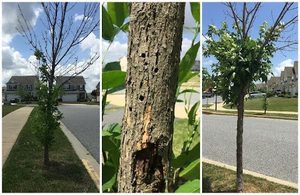
Come take a walk with me. It’s a sunny day towards the end of June, you just finished work, and it’s time to take the dog for a walk. Today we are walking through “Quail Run,” a suburban neighborhood anywhere in the mid-Atlantic United States. You look at the colonial style house to the left and notice the meticulously mowed lawn with large burgundy-leafed Norway maple protruding through a volcano of black mulch. Your gaze follows the strip in the lawn to the edge of the house where a row of boxwood is accented by Japanese barberry, both sandwiched between a dwarf Siberian spruce and a ‘Sky Pencil’ Japanese holly. You take a few more steps and notice the hedge of burning bush separating this house from the next. The following house isn’t so much different. On the edge of the driveway is a boulder with several tussocks of Miscanthus grass wafting near the adjacent sign that says, “Green Thumb Pest Control.” Providing some shade over the edge of the sidewalk, three Bradford pears jut from jet black mulch with thousands of small fruits developing and bearing the scars of broken limbs. The front of the house highlights a sterile weeping cherry, ‘Crimson Queen’ Japanese maple, along with the usual suspects of barberry and boxwood along the walkway to the front door. You pass some more houses with the same cookie cutter landscape and pallet, each neighbor boasting a greener, more manicured lawn than the next. The hum of mower engines, weed whackers, and leaf blowers, “VRMMMM…ZZZZZZ…VRMMM,” fills the calm afternoon breeze. A quarter mile down the road you approach a small wood lot and adjacent meadow with a sign up that says “Green Acres.” The edge of the woods has a massive white oak tree, a wolf tree, the only remnant evidence of what once was a flourishing ecosystem prior to becoming a farm field and then a neighborhood. English ivy ravenously crawling up the base of the white oak and is also smothering part of the forest floor. Deeper in the woodlot is an understory of Japanese barberry intermingled with multiflora rose swallowing up the spice bush begging for light. Where the woodlot meets the meadow is a thicket of 100+ stems of Bradford pear with long sharp thorns. You see some white flowers in the meadow pushing through the mugwort — it’s Queen Anne’s lace.
To the ordinary person this is the norm, but as an ecologist your heart sinks in lament or if you will, a state of ecological depression…But wait, you come across a patch of common milkweed! Milkweed! There is a swath of three dozen stems in full flower standing strong amongst the mugwort. An oasis for life in an ecological desert. The buzz of bumble bees helps drown out the hum of the mowers as they forage eagerly through the fragrant milkweed flowers. You spot an American lady butterfly and then a bright yellow tiger swallowtail! You see the two milkweed beetles on top of each other… are they…yes they are doing the Discovery Channel beetle style. You crouch down to get a closer look and see caterpillar droppings and freshly chewed leaves seeping out milky sap and then you spot it! A glimmer of hope amongst all these invasive species —the sacred monarch butterfly caterpillar, calm as could be, feasting on its host plant, milkweed.
This scene is all too common in the world we live in. We name the developments after the species that once thrived in these areas, “Beaver Creek,” “Heron Crest,” “Oak Hollow,” “Fox Ridge,” “Quail Run.” Everyone needs a place to live, not just us humans. What if I told you that we humans could coexist with just a few simple changes? Let’s keep walking.
You walk past a few more houses with the same mundane exotic invasive species that are far too common. A smile crosses your face as you round the corner to your street, Basswood Drive. You can smell it before you see it, the delightful fragrance of a sweetbay magnolia you bought at a native plant sale three years ago marking the corner of your property. As you get closer, you can see the flurry of black swallowtails, monarchs, spotted buckeyes, and more, swarming the blazing star, purple coneflower, and culver’s root layered around your mailbox.
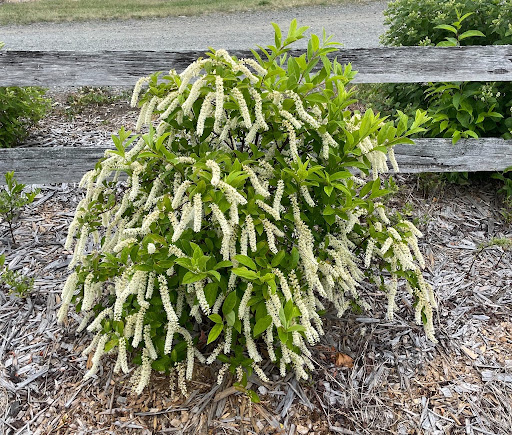
You make your way up the driveway pausing to admire the small green berries starting to form on the hedge of black chokeberry you planted when you moved in. These will become a cluster of dark purple berries bursting with a tannic, sweet juice come mid-August. They are a super food containing more antioxidants than any other berry. You decided to keep your native landscape a little more tame in the front of your house but have replaced the Japanese barberry with Virginia sweetspire. Not only does it have brilliant fall color, but its tubular clusters of hanging aromatic flowers coax in the pollinators. The boxwood was replaced with inkberry holly known for its glossy emerald green leaves and berries (food for song birds) but lesser known for its small white flowers that provide incredible value to pollinators. You accent your front walkway with tussocks of coastal little bluestem that leads up to your front porch which is accented by two healthy oak leaf hydrangeas.
Your side yard is a different story. It’s all but gone except for a meandering path through it which links the front to the back. It has succumbed to a layering of native perennial flowers. Along your side of the wooden fence dividing you and the neighbor’s property you planted spotted Joe Pye weed. The dense row is just about two weeks away from blooming proudly, standing 8’ tall. False sunflower follows, its bright yellow blooms reaching for the late afternoon sun. Swaths of scarlet bee balm are blooming fire engine red beckoning any hummingbirds in the area to zip over for a sip of nectar. A big ol’ fuzzy American bumble bee works over the first few flowers blooming on your wild bergamot. Skipper butterflies bounce from flower to flower avoiding the hundreds of bees in the airspace above the clustered mountain mint. A large great black wasp with its tinted iridescent wings burrows its head under the hood of a spotted horsemint flower to access its nectar leaving yellow pollen on the nape of its thorax. Although intimidating, they are gentle pollinators and a wonderful beneficial insect balancing the ecosystem you have created.
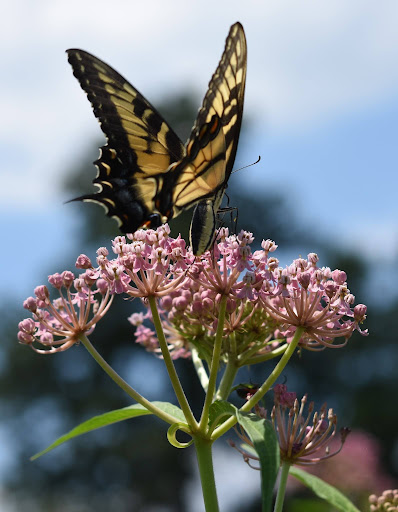
The soft pink flowers of swamp milkweed (Yes, despite the name it can grow in a moderately dry location!) are in full bloom where a metallic green sweat bee and common bumble bee forage side by side. Last week you spotted a monarch butterfly flitting above it. After closer examination, you find them… seven small monarch butterfly caterpillars feasting on the dark green foliage of the swamp milkweed plants. Holding the line up front is foxglove beardtongue clinging to its last white flowers of the season. It doesn’t end there. Mingled in are other species like Eastern columbine and golden alexander that bloom early and goldenrod and aster that bloom later in the season. Switch grass and little bluestem are pushing through in a few locations. This large portion of your side yard is enchantingly unbridled. It’s very low maintenance but when you do tend to it, it’s similar to sculpting. You Chelsea chop some leggy wild bergamot shading out your Ohio spiderwort. You rip up and relocate some blue mistflower that has encroached into your swath of hairy beardtongue. You trim the seeds heads off your tickseed and relocate them to the edge of the “Green Acres” woodlot you passed earlier. A white oak seedling no more than a foot tall proudly sits in the middle of your back yard protected by a cage from any hungry herbivores. You grabbed one acorn of thousands from under the giant white oak tree during a walk with your dog last September planting it directly in the ground.
You and your house are the anomaly on the street. After putting the mail in your box, the mailman leans out of his truck and snaps a photo of the tiger swallowtail butterfly on your blazingstar. Some of the people in the neighborhood think you’re crazy.The HOA has been called on you for having a “messy yard.” Your “pollinator habitat” sign” might as well say, “I’m a crazy native plant nutcase.”
But your persistence has paid off! You have influenced a few of your neighbors. Jimmy, your neighbor’s son, runs off the bus every afternoon eager to see what type of insects he can find. He especially loves finding the abundance of Carolina mantis’s on the slender mountain mint, sometimes eating honeybees! You educate him about metamorphosis then send him home with some milkweed stems and monarch caterpillars in a small terrarium so he and his little sister can experience the magic first hand by hatching and releasing Monarchs.
The house across the street loves the New England aster you gave to them, and you convinced your next door neighbor to plant a mass of the clustered mountain mint you dug up. It being the 2025 perennial plant of the year was your selling point.
Plants of Interest:
New Jersey Tea (Ceanothus virginiana)- 2-3’ tall, white flowers, blooms June- July. Great for pollinators – bees, butterflies and more! Leaves used for tea. Great replacement for barberry or small shrubs.
Virginia Sweet Spire (Itea virginiana)- 3-6’ tall, white flowers, blooms May-June. Great for pollinators especially small bees. Attractive fall foliage. Great replacement for Japanese barberry or boxwood.
Black Chokeberry (Photinia melenacarpa) 5-10’ tall, white flowers, blooms in Mid-April-May. Favorite of sweat bees, minor bees and other small pollinators. Produces beautiful dark purple berries that are highly nutritious and medicinal. Makes a great native hedge.
American Holly (Ilex opaca) 10-50’ tall, evergreen, blooms May-June. Great overlooked pollinator species. Supports lots of small bees and pollinators. Berries are great bird food especially loved by American robins.
Blazing Star (Liatris spicata) 2-4’ tall, purple flowers, blooms at the end of June-July. Pollinator magnet, especially butterflies! Seed is great bird food as well.
Culvers Root (Veronicastrum virginicum) 3-6’ tall, white-light purple flowers, blooms at the end of June-July. Pollinator magnet! More bees than butterflies.
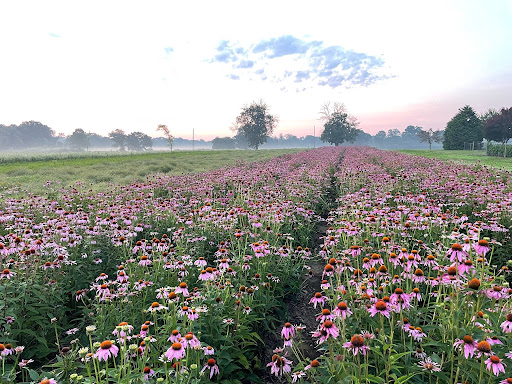
Purple Coneflower (Echinacea purpurea) 3-5’ tall, pink-purple flowers blooms at end of June-July. Favorite of all pollinators. Seed is a great source of food for goldfinches. Roots and buds have medicinal value. I dry the young buds and mix them with Monarda didyma and mountain mint spp. buds for a delicious tea.
Swamp Milkweed (Asclepias incarnata) 3-5’ tall, light pink to dark pink flowers, blooms end of june-july. Favorite of all pollinators. Host species of the monarch butterfly.
Common Milkweed (Asclepias syriaca) 3-5’ tall, pinkish purple flowers, blooms from mid June-early July. Monarch butterfly host species. Loved by bumblebees and many other pollinators. European honey bees will pollinate but their little hind legs can get trapped in the flowers. Young shoots and developing pods are edible.
Wild Bergamont (Monarda fistulosa) 4-7’ tall, light purple flowers, blooms mid july-early August. Favorite of pollinators especially tiger swallowtails and American bumble bees. Can be used for tea.
Spotted Horse Mint (Monarda punctata) 1-2’ tall, creamy white to pinkish flowers. Stigma lip is yellow with brown dots and area bees/wasps have to crawl into to access nectar. It blooms July- August and has a sharp mint fragrance. It is a favorite of many pollinators.
Scarlet Bee Balm (Monarda didyma) 3-5’ tall with deep red flowers, blooms mid June-July. Favorite of butterflies, bees, and attracts hummingbirds. Medicinal properties and makes a great tea!
Clustered Mountain Mint (Pycnanthemum muticum) 2-3’ tall white long lasting blooms from the end of June-September. Primary bloom time is July. Pollinator magnet! A couple sprigs mixed with lime juice, honey, tonic water, and rum makes a great natural mojito! This plan won the Perennial Plant of the Year in 2025
Foxglove Beardtongue (Penstemon digitalis) 2-4’ tall when flowering. The shorter basil rosette has green/burgundy leaves and when it blooms May-June, it will have several spikes of white flowers. Very attractive to bees and fun to watch them pollinate it.
Coastal little bluestem (Schizachyrium littorale) 2-4’ blueish green tussock grass that is as wide as it is tall. It sets seed mid-September and is an up and coming native ornamental grass. Similar to regular little blue but shorter, stouter, and more expressive in color.
Nature Boys Steve Integritea Recipe
Ingredient list:
1 handful of black chokeberry (fresh or frozen)
1 handful of elderberries (optional) (fresh or frozen)
1 tablespoon of Echinacea purpurea dried buds (fresh works too)
1 tablespoon of Monarda didyma dried stems and buds (fresh works too)
1 tablespoon of Pycnanthemum spp. dried buds. (fresh works too)
2 lemons
¼ cup of chopped ginger
½ lb. of honey
1 gallon or so of water
- Place berries in a large pot and muddle them with a wooden spoon then fill pot with a gallon or so of water
- Place pot on burner at medium heat.
- Add Echinacea buds, Monarda buds/stems, Pycnathemum bud, ginger, and juice of two lemons. You can add lemon halves to the concoction as well if you want
- Bring mixture to a simmer for about 10 minutes or so and shut off the burner. Strain buds/stems, berries, lemons and ginger from the tea.
- Add desired amount of honey for sweetness.
- Drink healthy medicinal tea hot or cold and enjoy!
Steve Knezick is the vice-president of Pinelands Nursery in Columbus, New Jersey. It is one of the largest native plant nurseries in the U.S. They also have their own seed production site at the nursery. His love of native plants is clear in this article and at their nursery.