By Thomas Prior, DCR Forest Health Specialist
According to the U.S. Forest Service, forest health is defined as “the production of forest conditions which directly satisfy human needs and by resilience, recurrence, persistence, and biophysical processes which lead to sustainable ecological conditions.” There are many threats to the health of our forested landscapes, including changing climate patterns, deforestation, invasive threats, and more. Some of the most pressing invasive threats to forests in Eastern North America are pests and diseases such as the emerald ash borer, southern pine beetle, hemlock woolly adelgid, and beech leaf disease. The Massachusetts Department of Conservation and Recreation (DCR) has protocols in place and works closely with other northeastern states to track and mitigate the spread of some of the greatest threats to the health of our forests.
Emerald Ash Borer
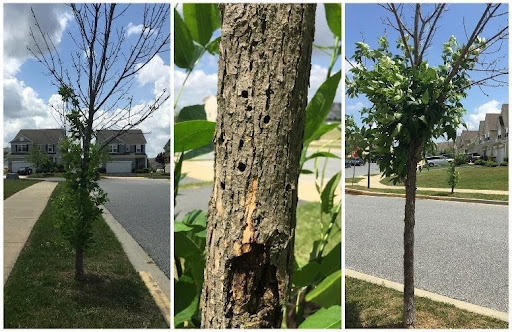
The damage from the emerald ash borer (EAB) is immediately apparent when looking at any remaining ash trees in Massachusetts. The bark is stripped in places, the leaf canopy is nowhere near as full as it once was, and there are epicormic shoots sprouting from the tree, which is a telltale sign of stress. Like most forest pests, EAB largely targets stressed and diminished trees first but can even burrow and lay its eggs in seemingly healthy host trees. The life of an EAB is short but it leaves a devastating impact on trees. Once larvae hatch, they begin to feed on the inner bark: the phloem, xylem, and cambium. As the larvae grow, they leave serpentine shaped tunnels in the inner bark, which over time work to destabilize the tree and can cause them to break apart and fall more easily than a healthy tree. Like many of the pests covered in this article, the EAB poses such a dire threat to our ash population because, unlike in their native Asia, there are no natural predators to feed on the EAB population and keep it from expanding.
The Massachusetts DCR Forest Health program has been studying the progression of the pest since its first recording in the state in 2012. Over the years, DCR Forest Health has chemically treated over 150 old growth ash across the state and has released hundreds of ecological biocontrols in the state to establish a safe population of predators to control EAB population growth. The released species were the egg parasitoid Oobius agrili, a larval parasitoid Tetrastichus planipennisi, and a larval parasitoid Spathius galinae. The entire state of Massachusetts is currently part of the national quarantined zone, limiting the movement of all hardwood firewood, green wood products, and any plant materials from any ash species to stop the spread of the beetle.
Southern Pine Beetle
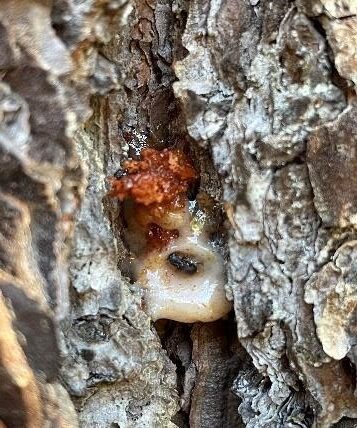
A southern pine beetle (SPB) is about the size of a grain of quinoa, but they can pack a mighty punch when hundreds or thousands descend upon a tree stand and make their presence known. The first physical signs of an infestation of SPB are little popcorn shaped waxy pitch tubes on a tree. The secretion of the waxy pitch tubes is the tree’s way of defending itself and trying to entrap or expel the beetles. Behind the pitch tubes and the bark of the tree, the damage from SPB is even more apparent with “S” shaped tunnels and galleries appearing in the heartwood of the tree. As the name implies, SPB is primarily found in the southern regions of the United States, but has been able to survive further north in previous decades thanks to climate change patterns allowing for winters in the northeastern U.S. to be just mild enough for them to thrive. SPB made its presence known in Massachusetts in 2023 after leaving a trail of environmental destruction in pitch pine stands in New Jersey and Long Island, New York.
Stopping an active infestation can be difficult and offers mixed results. Chemical treatments are rarely effective, leaving tree removals, known as suppression cuts, as DCR’s best option to control spread of SPB. SPB thrive in dense, even-aged pitch pine stands—often the result of decades without fire— because they are densely packed, stressed, and water-limited, which are all ideal conditions for beetle outbreaks. The solution is proactive management. DCR, along with partners at Mass Wildlife, have found that thinning trees, restoring open canopies, and using prescribed fires promotes regeneration and resilience among pine forests.
Hemlock Woolly Adelgid
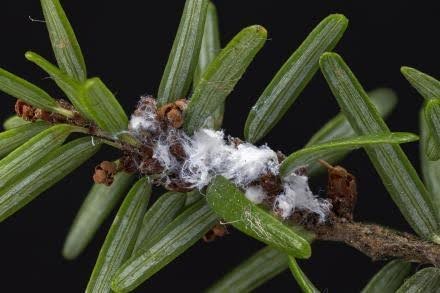
Hemlock woolly adelgid (HWA) has been a very common invasive species in the forests of North America since its introduction from Japan in the 1950’s. Native northeastern U.S. hemlocks — the eastern or Canadian hemlock (Tsuga canadensis) and the Carolina hemlock (Tsuga caroliniana)— show no resistance to HWA and have been severely impacted. Forested trees and ornamental plantings have been killed by this insect which has no natural predators in North America. Trees that are previously unhealthy due to a mix of factors are prime targets for HWA, which can weaken and eventually kill an infected host tree in as little as five years. Trees that are otherwise healthy can live with the infection for many years, especially if treated with pesticides. Signs of HWA infection are dieback on tree branches, tiny white masses that look like the tip of a cotton swab, and needle discoloration.
Massachusetts DCR sorts select hemlock stands into 3-year rotations to allow the team to treat certain trees with the pesticide, Dinotefuran, to save as many hemlocks as possible. The Forest Health team has also released biocontrol predator beetles over the years including Sasajiscymnus tsugae, Laricobius nigrinus, and Scymnus sinuanodulus to control the adelgid.
Beech Leaf Disease
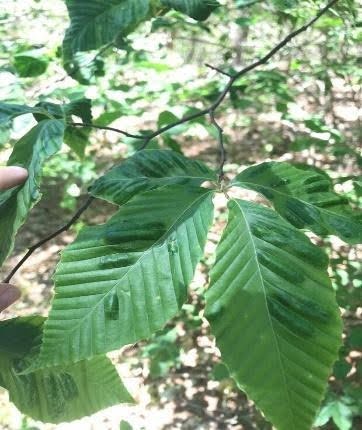
Beech leaf disease (BLD) is a newly discovered disease, first identified in Ohio in 2012. The disease causes damage to a tree’s leaves, leading to reduced vigor and can eventually lead to tree mortality. There are still many unknowns about how the disease is spread, how new trees are infected, or how long it takes for symptoms to develop. The most likely carrier for the disease is a nematode, Litylenchus crenatae. It is known that American beech, European beech, and Oriental beech can all be infected. The Massachusetts DCR Forest Health team has set up monitoring plots all over the state to survey the progression of the disease and track changes to both the trees themselves and the forest. BLD often causes leaves pushed out by beeches to appear striped and take on a curly appearance, which disrupts the ability of the leaf to photosynthesize, thus gravely harming the tree. BLD spreads rapidly and has been confirmed in every county in Massachusetts. Unfortunately, there is no known treatment for BLD infection, but there are several techniques to help protect healthy beech trees, such as foliar sprays and trunk injections of fungicides.
Thomas Prior is a Georgetown Massachusetts native, Tom graduated from Virginia Tech with a degree in Forest Resources and Conservation in 2019. After two years working for the National Park Service doing invasive plant management Tom has been with DCR as a Forest Health Specialist since 2021.